
Multi-Robot Systems
MAPF under Team-Connected Communication Constraint. This project addresses a multi-agent pathfinding problem under a team-connected communication constraint, where all agents must have a connected communication channel to the rest of the team during their entire movements. Standard multi-agent pathfinding approaches (eg, priority-based search) have potential in this domain but routinely fail when neighboring configurations at start and goal differ. Their single-expansion approach—computing each agent’s path from the start to the goal in just a single expansion—cannot reliably handle planning under communication constraints for agents as their neighbors change during navigating. Similarly, leader-follower approaches (eg, platooning) are effective at maintaining team communication, but fixing the leader at the outset of planning can cause planning to become stuck in dense-clutter environments, limiting their practical utility. To overcome this limitation, we propose a novel two-level multi-agent pathfinding framework that integrates two techniques: adaptive path expansion to expand agent paths to their goals in multiple stages; and dynamic leading technique that enables the reselection of the leading agent during each agent path expansion whenever progress cannot be made. Simulation experiments show the efficiency of our planning approach, which can handle up to 25 agents across five environment types under a limited communication range constraint and up to 11–12 agents on three environments types under line-of-sight communication constraint, exceeding 90% success-rate where baselines routinely fail. (view the paper — JAIR 2026)
Scalable Multi-Robot Motion Planning with Dynamics. This project addresses the multi-robot motion planning problem in unknown environments with dense obstacles an narrow corridors. The planning framework consists of a novel two-stage multi-robot adaptive motion planning technique; furthermore, an occupancy grid cell-based distance is introduced to represent the minimum distance a robot should cover before initiating the replanning process. Our framework reaches 90% success-rate with 7 snake-like robots and with 8 car-like robots in all but one of a set of challenging simulated environments, exceeding in all cases the performance of a competitive sampling-based motion planner baseline that struggles to reach 25% success in the most difficult cases. The framework also exhibits significant improvements in both runtime and travel distances. (view the paper — IEEE Access 2024)
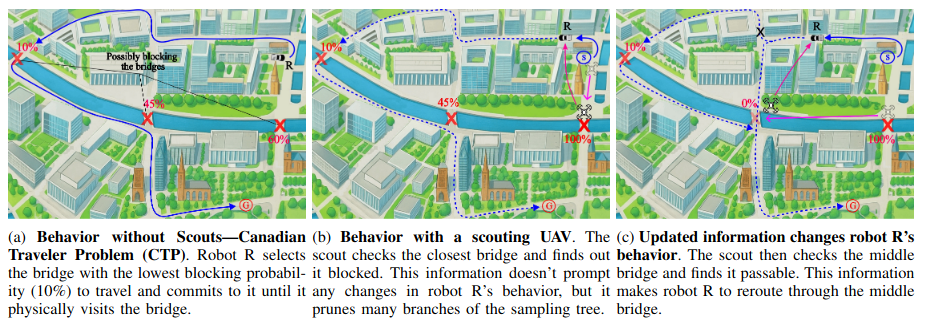
Scout-Assisted Planning for Ground Robot Teams The Canadian Traveler Problem (CTP) models navigation through graphs in which edges may be blocked, with blockages revealed only upon physical traversal. This uncertainty forces a ground robot into two costly outcomes: backtracking after committing to a road that proves impassable and conservatively choosing an expensive detour that is unlikely to be blocked. We revisit CTP under the premise that a robot team with a \emph{scout} can act on this uncertainty rather than merely react to it, and propose Scout-Assisted Planning (SAP)---a heterogeneous planning framework in which scouting UAV proactively reveal edge states to guide UGV navigation. Because scouting every uncertain edge is impractical, we introduce an Information-based Action Pruning (IAP) strategy that retains only the scouting actions whose outcomes are most likely to alter ground robot behavior. Since exact computation required of our pruning strategy prohibitively expensive, we train a GNN to estimate the value of information directly from graph structure and belief state, bringing planning to real-time speeds with only minimal plan quality loss. Across three environment types, our Learning-based Action Pruning (LAP) reduces UGV travel cost by 31.9--37.7\% over the standard CTP baseline and by a further 8--14\% over proximity-based scouting, showing that augmenting the CTP with information-gain-guided scouting is both more effective and computationally practical for real-world deployment. (view the paper)
Fleet Scheduler — Multi-Robot Dispatching, Coordination & Communication. Built the fleet-management stack for warehouse/factory robot fleets of up to 50 robots: priority- and cost-aware dispatching and scheduling so a long-running low-priority task can't hold up urgent work behind it; zone-based mutual exclusion across 51 managed zones to eliminate inter-robot blocking at pick-up/delivery points that no single robot's local planner could resolve alone; and a two-tier communication architecture — per-robot DDS domains to avoid quadratic discovery overhead, with MQTT/Mosquitto as the shared fleet plane — validated through Gazebo simulations of multiple robots operating together in dense-obstacle environments before deployment. (Bayro LLC — Dispatch Engineer, Mountain View, CA, Apr.–Aug. 2026.)